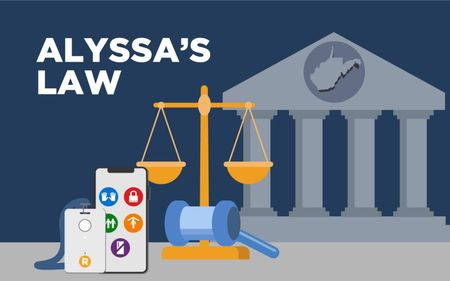
West Virginia Governor Patrick Morrisey signed Alyssa’s Law (House Bill 4798) on April 1, 2026. Alyssa’s Law, named after Alyssa Alhadeff who died in the 2018 Marjory Stoneman Douglas High School tragedy, requires schools in various states to implement or consider implementing silent panic alert systems linked directly to first responders and law enforcement agencies for expedited response times during emergencies. West Virginia now joins 11 other states that have enacted Alyssa’s Law.
Table of Contents
What Is Alyssa’s Law in West Virginia?
Alyssa’s Law in West Virginia permits wearable panic alert systems to be implemented at every public school in the state.
Administrators should note that the final version of West Virginia Alyssa’s Law does not require schools to implement a silent panic alert system, but it does outline what that system must be capable of, if adopted.
The legislation states that wearable panic alert systems for West Virginia schools should
- integrate with local Public Safety Answering Point (PSAP) infrastructure to transmit 911 calls and mobile activations
- initiate a campus-wide lockdown notification
Additionally, the bill outlines two requirements:
- annual training on device use and protocols prior to the first day of school
- law enforcement agencies have access to security data like maps
Schools in West Virginia can use these guidelines to help in their decision-making process.
How Raptor Helps Schools Meet West Virginia’s Panic Alarm Requirements
As West Virginia schools begin evaluating panic alert solutions, administrators need to consider partnering with a vendor whose solutions not only meet the capabilities outlined in the legislation but exceed them.
Raptor Badge Alert provides a silent panic alert system for school staff that goes beyond compliance by:
- enabling staff to send critical incident details directly to 911
- supporting multiple alerting options via a wearable device, mobile app, or desktop
- initiating push notifications, text messages, strobe alerts, desktop alerts, and PA announcements simultaneously through a single activation
- providing first responders with precise location details of the incident, with floor-location accuracy
- using a dedicated Long Range (LoRa) network to deliver alerts instantly, independent of cellular signal or Wi-Fi availability.
- providing battery level notifications for both users and administrators to help ensure devices remain charged and ready when needed
- integrating with Raptor’s Emergency Management platform to support preparation, response, and recovery for drills and real-world incidents
Considerations to Make When Evaluating Solutions to Meet Alyssa’s Law in West Virginia
The purchase of Badge Alert includes Raptor’s Emergency Management Software, which means schools will exceed legislative updates with available Critical Response Group (CRG) maps. CRG maps meet all of the standards outlined in HB 3166, which requires each county board to create standardized school safety mapping data, effective September 1, 2026.
CRG, endorsed by the West Virginia Sheriffs’ Association, is trusted by over the majority of school districts in West Virginia. Raptor’s CRG integration provides schools with detailed floor plans, aerial overviews, and layered campus visuals that give response teams the full picture of their environment.
What Funding Is Available for West Virginia Schools?
Alyssa’s Law in West Virginia also establishes the Alyssa Alhadeff School Safety Fund within the Treasury of the State to support the implementation of wearable panic alert systems and similar school safety equipment. The fund will be administered by the West Virginia Department of Homeland Security.
As of May 2026, more than $48,888 has been donated to the fund by Make Our Schools Safe and another $348,888 has been allocated by the West Virginia Department of Education. Additional legislative appropriations are expected to be requested once at least $5 million in private donations has been raised. Other details including the grant timeline (such as application start and end date), eligibility requirements, and more, are yet to be announced.
Additionally, schools with active awards from the following programs may leverage these funds to support wearable panic alert system implementation.
- COPS School Violence Prevention Program (SVPP)
- BJA STOP School Violence Program
- The State Homeland Security Grant Program (SHSP)
For those interested in applying this year, the next cycles for these programs are expected to open in the spring (SVPP), summer (STOP), and between late spring and mid-summer (SHSP) of 2026.
Other States with Alyssa's Law
Several states have already passed Alyssa’s Law and many other states have pending legislation.
Related Resources
Understand your options for choosing the most reliable panic alert system for your school in our guide: A Case for Wearable Panic Alerts: Helping Schools Choose and Adopt the Right One