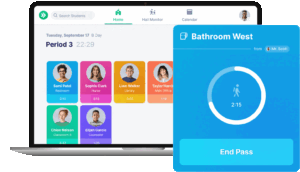
Student movement management is one of the most frequent accountability gaps that schools face. For public school districts, there’s usually a framework in place to help close that gap: district-level policies, dedicated security staff, and standardized systems and tools that roll out across every campus.
For private and charter schools, managing student movement can be more challenging as they operate with more autonomy but fewer centralized resources than traditional public schools. Still, effective solutions like digital hall passes help schools of any type build stronger student movement accountability.
By pairing targeted strategies built for their unique environments with purpose-built student movement software, private and charter schools can reduce hallway disruptions, protect instructional time, and improve student safety and accountability.
Table of Contents
Why Student Movement Management Matters
Consider how many times a student is outside the classroom in a given school day:
- passing periods between classes
- bathroom breaks during instructional time
- trips to the nurse or the counselor
- check-ins at the front office for late sign-in or early pick-up
- visits to the library or media center
- flex-period activities
In schools with more progressive scheduling models, that list gets even longer. Each one of those transitions represents a student who is in your building, under your care, and not directly supervised by a staff member. Multiply that across a student body, and the complexity of managing campus movement effectively becomes clearer.
Leaving student movement unmanaged creates significant risks and disruptions throughout the school day, including
- Instructional time loss. A student who takes a ten-minute bathroom break three times a day is missing fifteen or more minutes of class. If that happens every school day, the cumulative learning loss is significant. Schools that use paper hall passes might not see this pattern until it’s been going on for weeks or months.
- Behavioral incidents. Student vaping, bullying, unauthorized meetups, and hallway confrontations don’t happen randomly. They happen in under-supervised spaces during unstructured time. When schools have visibility into who is in the hallways and why, they can work to prevent many of these incidents before they happen rather than respond to them after the fact.
- Lack of emergency accountability. In an emergency, staff need to know immediately where every student is. If a student left class on a bathroom pass ten minutes ago, is that accounted for? Paper-based or informal systems make this nearly impossible to answer in real time.
- Erosion of positive school environment. The physical experience of moving through a school shapes students’ sense of safety, school values, and behavioral expectations. A chaotic hallway can communicate the wrong message to students as well as staff and visiting families.
Most private and charter schools that struggle with hallway behavior management may feel they have a discipline problem. Instead, it’s more of a systems problem. The behavioral expectations for students are in place, but independent schools may lack the tools and structures to support and enforce those expectations consistently, across every teacher, every period, and every student.
Student Movement Management for Private Schools: Challenges and Solutions
Private schools occupy a distinct position when it comes to student movement. On one hand, they have more freedom than almost any other type of school: freedom to set their own schedule, design their own campus culture, and define what “good behavior in the hallways” looks like on their own terms. On the other hand, that freedom comes with some significant pressures, including
- High parent expectations. In a private school, families are paying customers and investors in the institution. They have high expectations for the academics, culture, and safety and order of the environment they’ve chosen for their child.
- High-achieving students. Private school students often come from families with higher academic expectations. When something goes wrong, like a fight in a stairwell, substance abuse in bathrooms, or chronic hallway wanders missing class, there is more scrutiny from staff, parents, and peers.
- Reputational sensitivity. Word travels quickly in small private school communities. A safety incident during a hallway transition or a pattern of behavioral problems carries real enrollment and reputational risk.
5 Common Student Movement Challenges for Private Schools
In addition to the unique factors that contribute to the high scrutiny private schools face, there are also operational and cultural challenges that increase the complexity of how they manage student movement.
- Inconsistent systems across classrooms. Private schools often prize teacher autonomy. But when every teacher has their own approach to hall passes—a sticky note here, a verbal “go ahead” there—students receive mixed messages, administrators have no reliable data, and accountability breaks down.
- No district infrastructure to default to. Public school teachers can reference district policy. Private school teachers are working from whatever the school has built internally. If that system is vague, outdated, or simply not enforced consistently, there’s no outside body to flag the gap.
- Limited administrative capacity. Private schools often operate with lean administrative teams responsible for a wide range of functions, from admissions and parent communications to discipline and operations. Without dedicated staff focused on hallway supervisions or student accountability, movement management becomes a distributed responsibility.
- Balancing culture with accountability. Many private schools prioritize building student accountability and independence. This can conflict with processes that provide more structured oversight, like managing student transitions or employing digital hall passes. The challenge lies in framing movement management not as monitoring students or removing their autonomy, but as another tool to help keep them engaged in class and accounted for.
- Complex schedules and spaces. Private schools often operate with non-traditional schedules that can include advisory blocks, chapel, athletics, and arts programming. They may also have to deal with the complexity of unique campuses, including shared-use spaces and boarding facilities. Without a centralized system, it becomes difficult to track who should be where at any given time or to identify congestion points and supervision gaps.
4 Student Movement Strategies That Work for Private Schools
Effective student movement management in private schools focuses on consistency, visibility, and alignment with school culture. Here are some practical strategies to follow when establishing your private school student movement management practices:
- Make student movement accountability part of the culture. Private schools have the freedom to define what their hallway culture looks, sounds, and feels like, connecting it explicitly to the school’s values. A school that emphasizes respect and community can frame hallway behavior as an expression of those values, not just a rule to follow. This kind of framing tends to get more buy-in from both students and faculty than a generic policy document.
- Build consistency without eliminating autonomy. Private school faculty often value independence and autonomy, for themselves and their students. Rather than removing individual teacher judgment and telling them explicitly when students can and can’t leave class, a school-wide digital hall pass system creates a consistent record of student movement while allowing teachers to set their own classroom-level policies.
- Use parent-facing data as a trust-builder. When parents can see that the school has systems in place to account for their child’s time and safety, that data becomes a talking point, not just a discipline tool. Schools that can say “here’s how we keep students in class and learning” are ahead of most of their peers.
- Conduct periodic movement audits. At least once per year, school leadership should walk the campus during passing periods and ask: Where are the bottlenecks? Where is supervision weakest? Where do incidents cluster? A simple physical audit can surface issues that data alone doesn’t capture, and it signals to staff that leadership takes transitions seriously.
How Charter Schools Can Manage Student Movement: Challenges and Solutions
Charter schools are publicly funded but independently operated, which gives them a different accountability structure from private schools and traditional public schools.
Some pertinent student movement concerns for the charter school environment include
- Performance-based accountability. A charter school’s authorizer—whether it’s a school district, a university, or a state charter board—holds the school accountable not just for academic outcomes, but for operational compliance and safety. How a charter school manages student movement can become part of the documented record of how well the school is run.
- Lean resources and staffing models. Many charter schools operate with tight margins for staffing and operational budgets. They often can’t hire dedicated hall monitors, security staff, or an administrative team large enough to cover every corner of the building. Any system for managing student movement has to be low-lift to implement and maintain.
- Diverse student populations. Charter schools tend to serve many students with complex needs, like English Language Learners (ELLs), students with IEPs and behavior intervention plans (BIPs), and students navigating significant life challenges outside of school. For these students, movement management helps provide the structure and consistency that supports their learning and wellbeing.
4 Common Student Movement Challenges in Charter Schools
These structural realities are interconnected with the day-to-day operational challenges that charter schools face in managing student movement. Limited staffing impacts supervision, which affects consistency, which in turn impacts data and accountability.
- Limited hallway supervision. Charter schools often operate without dedicated hall monitors or security staff, relying instead on teachers and administrators with already full plates. During passing periods or class time, this can lead to large areas of the building going unsupervised, increasing the likelihood of risk and disruptions.
- Increased need for structured support. Many charter schools serve students who benefit who might require more structured movement management. For example, a student with a BIP may have specific protocols for unsupervised transition time, which locations require additional support, and how hallway incidents should be documented. Tracking those nuances in a paper-based system creates undue administrative burden on staff and more opportunity for error, opening the school and student up to real risk.
- Pressure to demonstrate operational effectiveness. Charter schools are expected to show that they’re running a safe, well-managed school. Movement data—including pass usage patterns, hallway incident rates, time-out-of-class trends—is increasingly the kind of operational evidence authorizers want to see, especially during renewal conversations.
- Ability to scale consistently and efficiently. For schools operated by a charter management organization (CMO), a hallway management system that works at one campus needs to work at five or fifteen. Inconsistency across network campuses, to say nothing of inconsistencies within a single school, create risk both operationally and reputationally.
4 Student Movement Strategies That Work for Charter Schools
Effective student movement management for charter schools emphasizes efficiency, clarity, and intentional use of data to drive improvement. The following strategies can help your charter school develop more effective student movement management practices:
- Adopt a tiered movement protocol. Not all student movement carries the same risk level. A framework with three tiers—standard movement (routine bathroom breaks, nurse visits), restricted movement (students with frequent patterns of misuse or behavioral concerns), and emergency lockdown—gives staff a clear language and set of responses without requiring them to make complex judgment calls in the moment.
- Integrate movement management with behavioral frameworks. If your school uses PBIS (Positive Behavioral Interventions and Supports) or MTSS (Multi-Tiered System of Supports), your hall pass system can work in tandem with those frameworks. Movement data can be an early warning sign: A student who’s suddenly taking frequent, long bathroom breaks, or who’s consistently late returning from passes, may be signaling something worth investigating before it becomes a bigger issue.
- Use a digital hall pass system to reduce burden on small teams. Digital hall passes can help small teams function more effectively without adding to their workload. When a front office administrator can see in real time that a student left class eleven minutes ago heading to the bathroom and hasn’t returned, they can act on that information without waiting for a teacher to call down. That kind of student visibility is transformative in a school where every adult is already stretched.
- Leverage data for charter accountability and improvement. Pulling movement reports regularly, instead of just when something goes wrong, gives schools insight into time-out-of-class trends, frequent flyer patterns, and hallway incident data. These are all useful inputs for the operational reporting that authorizers want to see. Schools that can walk into a renewal meeting with this data are telling a more compelling story about how they run their building.
A More Effective Approach to Student Movements
Private and charter schools are uniquely positioned to build student movement management systems that reflect their mission and priorities. When supported by the right strategies and software, movement management schools can reduce disruptions, protect instructional time, and create environments where students and staff can focus on learning.
Solutions like Raptor SmartPass help schools
- identify and block problematic behavior, like bathroom vaping, vandalism, and meetups
- implement consistent, standardized hall pass processing across classrooms
- reduce administrative burden on staff while supporting accountability and flexibility
See how SmartPass can meet your school’s student movement needs.
Recommended Resource
Explore how digital hall passes can minimize disruptions and improve student accountability with our complete Digital Hall Pass Guide.