Keeping Tennessee Schools Safe
Prevent, prepare, respond and recover from any emergency
Alyssa’s Law
Alyssa’s Law, as part of House Bill (HB) 322, requires district-wide and building-level school safety teams to consider including a mobile panic alert system in their respective safety plans. These systems must:
- Be capable of connecting diverse emergency services technologies to ensure real-time coordination between multiple first responder agencies.
- Integrate with local public safety answering point infrastructure to transmit 911 calls and mobile activations.
See how Raptor Alerting solutions support Alyssa’s Law compliance in Tennessee Schools.

Request a Demo

Raptor Alerting Solutions
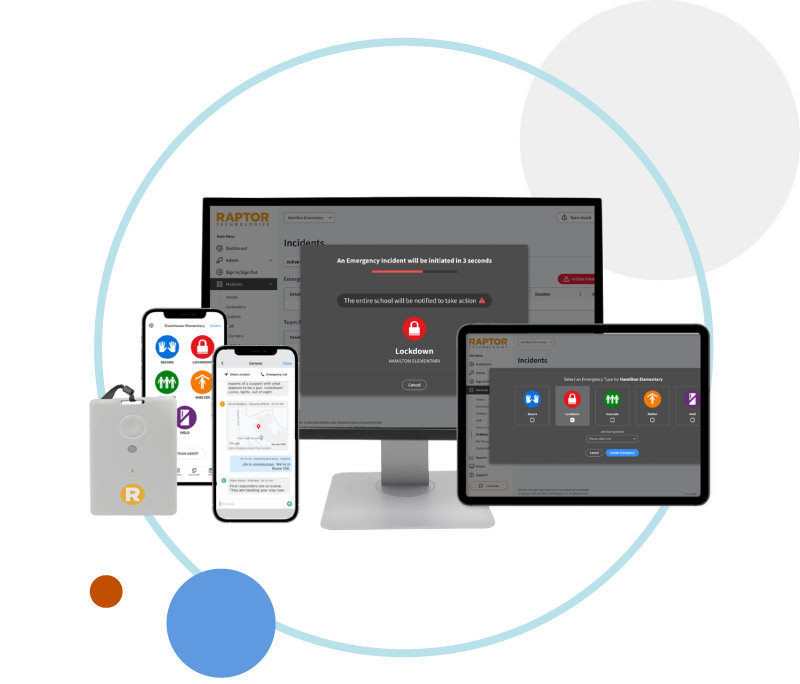
Raptor provides multiple alerting methods to enable staff to silently and more easily expedite the call for help during emergencies, ensuring compliance with Alyssa’s Law. Designed to work under duress, Raptor Alert and Raptor Badge Alert provide a silent panic alert system for school staff. The system:
- Integrates with existing digital security systems, maps, and peripherals through the Raptor Connect bi-directional integration platform, streamlining a school’s digital emergency response activations, speeding notifications, and minimizing the impact of the situation.
- Is compatible with all standard Public Safety Answering Points and emergency calling infrastructure, and is RapidSOS Ready, accelerating the transfer of critical emergency alert data to 911 and with first responders during emergencies.
What Our Customers Say
“The way to keep your schools or anywhere safe is adding those extra layers of security that it takes to put between people that don’t need to be there, and the school community, and Raptor is a system that we use that provides another layer of safety and security for us.”
Tim Gilmer, Chief Support Services OfficerJackson-Madison County Schools
“It was an individual that was coming to campus for the first time, who was going to do some contract work and with new visitors, he was screened in and there was a flag. He never had an opportunity to work in our schools and he was immediately escorted out of the building.”
Jerry Boyd, Superintendent Washington County Tennessee Schools
For a decade since my involvement with Raptor, I have experienced continual support from the Sales, Customer Success, and especially the Technical Support teams. The Raptor teams were invaluable at each step along our implementation and enhancement journey. Their national growth, in my perspective, is directly tied to their customer-centric focus.
Robert Williams, Systems AnalystMemphis-Shelby County Schools
Ensure Compliance with Tennessee School Safety Mandates
See how Raptor solutions support compliance. Select a bill or statute below for details.
114th General Assembly
HB 1550
House Bill 1550: Prepares public and nonpublic schools to treat allergic reactions with epinephrine
Anaphylaxis & Allergy Preparedness
Requirements
Schools may maintain epinephrine, recommended to be in a form that can be administered to a student experiencing a life-threatening allergic or anaphylactic reaction, stored in at least two unlocked, secure locations. School nurses or other trained personnel may administer the epinephrine if the student does not have a personal supply or a prescription on file.
Learn MoreRaptor Compliance
Raptor Staff Compliance Training, powered by PublicSchoolWORKS, offers 3 courses related to epinephrine use and administration.
113th General Assembly
HB 322
House Bill 322: Requires threat assessment teams, annual safety plans, incident command drills, and active shooter training for private security
Threat Assessment & Safety Planning
Requirements
In addition to requiring schools to consider implementing mobile panic alert systems, HB 322 also requires each LEA to establish a threat assessment team, and every public and private school to develop annual safety plans, including an incident command drill for school leaders and law enforcement.
Learn MoreRaptor Compliance
Raptor StudentSafe™ supports district threat assessment teams in capturing low-level concerns, streamlining behavioral threat and suicide risk assessments, and managing cases of bullying, sexual harassment, and other well-being concerns.
Raptor Drill Manager allows public and private schools to automate scheduling, conducting, and reporting on mandated drills.
Tennessee Code Requirements
TCA § 49-50-1602
TCA § 49-50-1602: Allows trained volunteer school staff to administer emergency anti-seizure medication
Seizure Safety & Staff Training
Requirements
Allows trained volunteer school staff to give emergency anti-seizure medication if a nurse can't respond in time. At least one full-time employee at each school must receive annual training in seizure safety and first aid. A nurse must provide annual training and CPR instruction, and volunteers' skills must be documented.
Learn MoreRaptor Compliance
Raptor Staff Compliance Training, powered by PublicSchoolWORKS, offers 11 courses related to seizure response to meet the unique needs of your staff and students. Additionally, Raptor VolunteerSafe collects required information, documents, and preferences based on volunteer roles and responsibilities.
TCA § 37-1-408
TCA § 37-1-408: Requires annual staff training on child abuse, child sexual abuse, and human trafficking
Child Abuse & Trafficking Prevention Training
Requirements
All public school and charter school employees who work directly with students must complete annual training on child abuse, child sexual abuse, and human trafficking. Schools must also report their compliance each year to the Department of Education.
Learn MoreRaptor Compliance
Raptor Staff Compliance Training, powered by PublicSchoolWORKS, offers 7 courses related to sexual abuse and human trafficking prevention, and 22 courses related to child abuse prevention.

Available Funding
The state of Tennessee has allocated funding to enhance school safety, and additional federal grant opportunities are available to further support these initiatives. The following programs align with Raptor’s solutions:
$20M Public School Security Grant
The Public School Security Grant provides $20M in reimbursement grants to public schools throughout Tennessee for enhancing school safety for students and staff.
Allowable expenses include:
- visitor management,
- panic alert devices,
- emergency operations planning,
- violence prevention programs,
- and safety training for staff members.
The obligation deadline for the FY26 Public School Security Grant has been extended. This means any unspent grant funds may be carried over into the upcoming fiscal year (FY27) when schools complete their Final Expenditure Report (FER), which will be available beginning July 1, 2026, and due by October 1, 2026.
FY26 COPS SVPP
Expected Award Period: 36 months starting on October 1, 2026
The FY26 Community Oriented Policing Services School Violence Prevention Program (COPS SVPP) will provide an estimated total of $73M for K-12 school security improvements. Allowable expenses include:
- panic alarm notification systems
- security systems and accompanying equipment
- school maps
- visitor management systems
- and more
FY26 School Safety Enhancement Program
Project period: Up to 36 months
The FY26 School Safety Enhancement Program will provide a total of $93M to State Educational Agencies (SEAs) for school safety systems and physical security. Allowable expenses include:
Allowable expenses include:
- deterrent measures
- visitor screening infrastructure
- emergency communications systems
- active threat response training
Related Resources

Alyssa’s Law in Focus: Enhancing School Safety with Silent Panic Alarms
Join our experts for a deep dive into Alyssa’s Law and the pivotal role of silent panic alert technology.
Jackson Madison County Schools Promote Safety by Using Raptor System
Learn how Raptor is helping Jackson Madison County Schools and other Tennessee schools keep unwanted entrants out.