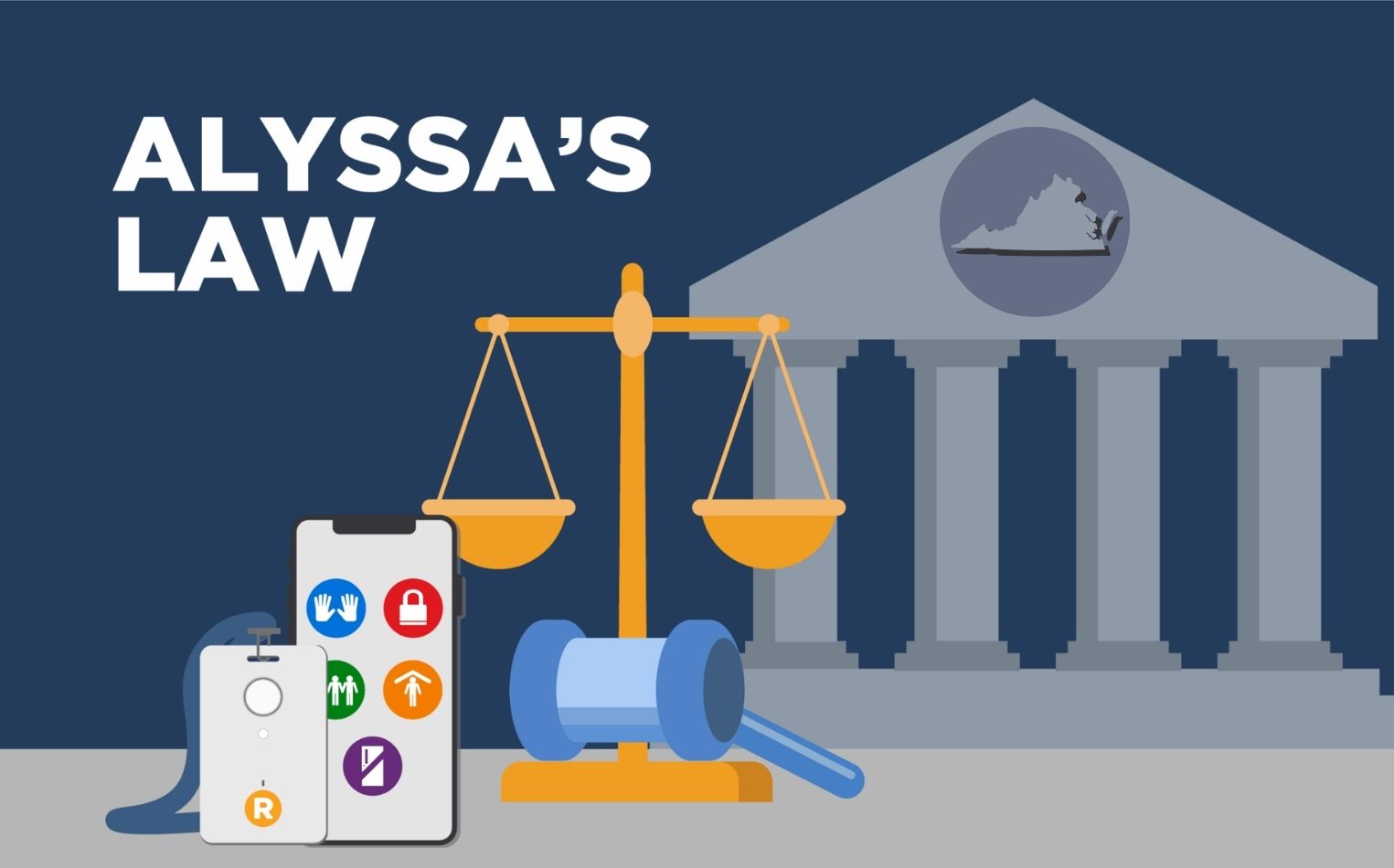
Virginia Governor Abigail Spanberger signed Alyssa’s Law (House Bill 592) on April 2, 2026. With the passing of this important bill, Virginia now joins 11 other states that have passed laws with varying requirements around the implementation of silent panic alarms in schools.
Named Alyssa’s Law in honor of Marjory Stoneman Douglas High School student Alyssa Alhadeff, this bill is a critical step in encouraging schools to protect students and staff more quickly in emergencies.
Table of Contents
What Is Alyssa’s Law in Virginia?
- sends a signal to the local 911 Public Safety Answering Point (PSAP) indicating an emergency requiring immediate response
- activates a multisensory schoolwide school security emergency notification as needed
How Raptor Aligns with Virginia’s Panic Alarm Requirements
Raptor Badge Alert meets and exceeds both requirements for Alyssa’s Law in Virginia. It’s important that administrators consider a comprehensive system like Raptor that helps them stay compliant as state laws may evolve in the future.
Direct Communication to PSAPs
Badge Alert enables staff to activate a silent alert with a button press from their wearable badge to send critical incident details directly to 911 dispatchers via RapidSOS. First responders receive details such as address, entry points, and floor-specific location information, so they are well prepared upon arrival.
Direct communication to Public Safety Answering Points (PSAPs) via a dedicated LoRa network means alerts reach 911 even when cell service or Wi-Fi is inconsistent.
Multisensory, School-Wide Emergency Notifications
The Badge Alert system integrates with existing school tools for multi-channel communication, including push notifications, text messages, strobes, desktop alerts, PA announcements, and other connected safety systems.
Automated workflows for alerts can be customized to each schools’ needs and environments, minimizing manual steps that can increase safety gaps in critical moments.
Other Important Safety Measures
Aside from meeting the requirements for Alyssa’s Law in Virginia, Raptor’s Emergency Management Software provides schools with additional layers of security and response that helps keep students, staff, and visitors safer.
Badge Alert also
- provides first responders with precise location details of the incident, with floor-location accuracy
- shows campus-specific maps for district safety staff and first responders through the Raptor Emergency Management dashboard
- includes Raptor’s Emergency Management software to provide robust preparation, response, and recovery efforts for drills and real-world incidents
- uses a dedicated Long Range (LoRa) network that transmits alerts instantly, regardless of signal strength or Wi-Fi capabilities
- includes low battery level alerts for the user and administrators, keeping the badge ready for use at any moment
These features work together to provide a stronger emergency response in critical moments, helping schools be better positioned when a crisis unfolds
Additional Considerations to Make When Choosing an Alyssa’s Law Solution
Raptor’s alerting solutions exceed the capabilities outlined in the legislation by directly integrating Critical Response Group (CRG) maps within the Emergency Management platform. This supports compliance with Virginia Code § 22.1-279.8, which requires school boards, as part of annual audits, to create detailed and accurate floor plans for each public school building or certify that existing plans meet those standards.
CRG, endorsed by the Virginia Association of Chiefs of Police, is trusted by more than 150 school districts and 2,000 schools in Virginia. This widespread adoption reflects its reliability and value in supporting school safety initiatives statewide.
Raptor’s integration with CRG enhances emergency response in schools by enabling layered mapping, aerial overviews, and detailed visuals of building and campus layouts, which improves situational awareness and more coordinated responses.
What Funding Is Available for Virginia Schools?
At the state level, the Virginia’s Security Equipment Grant explicitly lists “wearable panic alarm system” among its allowable expenses. The application period opens July 1, 2026 and closes August 1, 2026.
At the federal level, schools with active awards from programs such as the COPS School Violence Prevention Program (SVPP), BJA STOP School Violence Program, and the State Homeland Security Grant Program (SHSP) may leverage these funds to support the implementation of wearable panic alarm systems. Looking ahead, the FY2026 funding cycles for these programs are expected to open in the spring (SVPP), summer (STOP), and between late spring and mid-summer (SHSP).
What Other States Have Passed Alyssa's Law?
Several states have passed Alyssa’s Law, with varying requirements, and others have legislation pending.
Related Resources
Understand your options for choosing the most reliable panic alert system for your school in our guide: A Case for Wearable Panic Alerts: Helping Schools Choose and Adopt the Right One