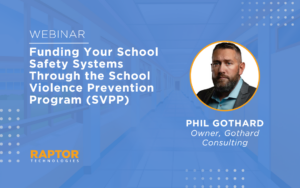
The COPS School Violence Prevention Program (SVPP) grant offers districts an opportunity to bridge one of the most common gaps when it comes to school safety initiatives: funding. But the process of winning a COPS SVPP grant is highly competitive and complex, making it essential to have clear guidance.
Many districts miss out on school safety funding due to avoidable mistakes, like starting too late, submitting vague plans, or misunderstanding grant requirements. Districts that take a proactive approach and follow advice from school safety grant experts can strengthen their applications for COPS SVPP funding.
Table of Contents
Why the COPS SVPP Grant Is So Competitive
The COPS School Violence Prevention Program (SVPP) is a federal grant that helps K-12 public schools fund safety infrastructure like access control, surveillance, and communication systems. Unfortunately, demand far exceeds available funding.
This creates a highly competitive environment where only the strongest applications make it through. In 2025, the COPS Office awarded a total of $74.7M to 211 SVPP grant recipients, just a small fraction of the 1,609 districts that applied.
To help narrow down the competition, the SVPP application and review processes are lengthy and complex.
- Applications require multi-step submissions across multiple systems.
- Districts must develop detailed narratives that clearly explain need, approach, and projected outcomes.
- Supporting documentation, including budgets, vendor quotes, and letters of support, must align with that narrative.
Evaluators are not just looking for schools with the greatest need. They are evaluating how well a district understands its own environment, how clearly it can define its challenges, and how effectively it can propose a well-researched solution.
In practice, that means districts with similar needs can have very different outcomes based entirely on the quality and completeness of their application.
Common School Safety Grant Mistakes to Avoid
The competitive nature of and scope of work required by the SVPP grant deters some districts from applying at all.
“If you’re truly going to represent your school in a way that’s going to set you apart from your competition, that’s quite a bit of work,” says Phil Gothard, owner of Gothard Consulting, a private firm that helps schools navigate complex federal funding opportunities. “And if you don’t have somebody who’s dedicated to that role in your district, that’s a lot for somebody else to do in addition to their normal roles.”
Many districts don’t have the time and resources to spare on unsuccessful grant applications, yet they are the districts that would likely benefit the most from additional school safety funding. A closer look at some common mistakes made on SVPP grant applications can help districts avoid these same pitfalls and improve their chances at an award.
1. Waiting Too Long to Start
One of the most common mistakes districts make is waiting until the application window opens, typically spring to early summer.
By that point, timelines are compressed. Teams are already managing end-of-year responsibilities, and the amount of work required to assemble a strong application becomes difficult to manage.
What makes this particularly challenging is the complexity of the SVPP application itself. In addition to filling out the application, districts must
- register in SAM.gov with a Unique Entity Identifier (UEI) number
- register in Grants.gov and complete the SF-424 form
- compile data and vendor quotes to support specific requests
- acquire letters of support and memorandums of understanding
- draft a detailed grant proposal and funding plan
It’s a multi-step, complicated process that requires input across multiple systems, detailed narrative development, persuasive storytelling, and careful coordination between departments, external vendors, and stakeholders.
Districts that start late typically experience
- rushed narratives that lack depth or clarity
- missing, incomplete, or vague documentation
- limited stakeholder input and alignment
Many districts are trying to assemble something that meets minimum requirements in a time crunch and are unable to provide the detailed information that winning applications put together. The COPS SVPP grant is simply too competitive for that to be effective.
What to do instead:
- Start planning several months in advance.
- Assign ownership early and map out the full application process.
- Review prior-year application materials to understand expectations.
- Begin gathering vendor quotes, documentation, and stakeholder input early.
For smaller districts that don’t have a dedicated grant writer or team, these responsibilities often fall on administrators with already full plates. It can be helpful to hire a consultant with experience in school safety grants, particularly one who may offer their services pro bono.
2. Not Understanding Requirements and Allowable Expenses
A strong application must be well-written and compliant. Districts can invest significant time building a proposal only to weaken it by including items that are not allowable under SVPP guidelines or by misaligning requests with program requirements.
This issue often happens when teams assume that common safety investments will automatically qualify.
“You have to make sure that everything is compliant, and you’re not inadvertently asking for something that’s not allowed,” says Gothard. “That could sabotage your whole application.”
Common mistakes around requirements and allowable expenses include
- Requesting unallowable costs. Including items or costs that are not explicitly allowable under SVPP guidelines, like funding for Student Resource Officers to improve student wellbeing and security, can jeopardize an entire proposal.
- Misalignment with grant priorities, e.g., proposing spending grant funds to support student mental health and wellbeing. While important, this is not aligned with the grant’s explicit mission of improving security infrastructure.
- Misunderstanding compliance requirements. Before submitting, districts should have a complete understanding of award requirements, including things like mandatory disclosures, local match requirements, and compliance with federal and state laws.
What to do instead:
- Carefully review SVPP application guidance and allowable expenses.
- Validate planned investments against program requirements before drafting.
- Work with partners and vendors who understand grant compliance.
Understanding and ensuring compliance early in the process helps prevent avoidable issues that could get your grant application rejected on technicality.
3. Submitting Vague or Generic Plans
SVPP evaluators review a high volume of submissions to assess both need and preparedness. They’re looking for evidence that districts understand their security challenges and have a clear plan for addressing them.
Applications that lack the specificity that evaluators want often include
- budgets based on estimates rather than real quotes
- undefined quantities or unclear scope of implementation
- generic descriptions of needs without clear connection to solutions
“If you’re doing really generic, round number, ‘guesstimate’ math on your budget,” explains Gothard, “Not only are you probably going to be off in one direction or another, but an evaluator is also going to see that you didn’t really do your due diligence.”
What to do instead:
- Use actual vendor quotes with clearly defined quantities per school and in summation, e.g., “62 wearable panic alert badges for Central Elementary School” instead of “50 wearable panic alerts per school.”
- Provide detailed explanations of how each investment addresses a specific risk or gap. This requires detailed planning and evaluation of school campuses to identify specific needs like inadequate visibility near an entrance or malfunctioning door locking mechanisms on an older classroom building.
- Ensure consistency between narrative, budget, and supporting materials. Every piece of the proposal should work together and tell the same story.
“Specificity always wins over being generic,” says Gothard.
Precise, grounded evidence helps districts prove specific needs and outline a clearer plan for how funding will be used to address those needs, strengthening the overall credibility of the application.
4. Failing to Involve the Right Stakeholders
The COPS School Violence Prevention Program was designed with the expectation of collaboration both within the district and across the broader community.
“The acronym ‘COPS’ stands for ‘Community Oriented Policing Services,” Gothard explains. “So, it’s clear that the intent the Department of Justice is communicating here is that they want the community to collaborate in these efforts. They want different people’s voices to be heard, not just law enforcement, but school leaders and administrators, teachers, social workers, mental health professionals, and security professionals. [They] want buy in from everybody.”
Applications without input from necessary stakeholders often fail to reflect a district’s safety environment and convey a disconnect from real-world implementation. And even if these kinds of applications do secure funding, they can still present problems post-award when it comes time to start using the funds.
“The funding amount has already been set,” says Gothard. “It’s fixed. And now you’re trying to divide up a pie into more slices than you had originally intended. It’s so important to just get that collaboration and buy in right away so that everyone’s needs are being heard.”
What to do instead:
- Engage key stakeholders early in the planning process, including
- law enforcement and emergency responders
- student-facing staff like teachers, counselors, and coaches
- IT, operations, and facilities teams
- Document collaboration through letters of support or formal agreements.
- Ensure the final plan accurately reflects input from across these groups.
5. Focusing On Pieces Instead of a Complete Safety Plan
Districts that approach school safety funding as a list of purchases often miss the bigger picture. For a highly competitive grant like SVPP, that can make a significant impact on an application’s chances of success.
Grant applications that struggle in this area may include strong individual components, like access control, cameras, or communication tools, but fail to demonstrate how those pieces work together or how they will be implemented in practice.
This can look like
- investments that are not integrated into daily operations (e.g., new systems with no defined ownership or workflows)
- failing to account for gaps between new system capabilities and staff training
- no clear plan for implementation, including timelines, roles, and ongoing management
Without a cohesive strategy, even well-funded safety initiatives can struggle to deliver meaningful outcomes. Evaluators are looking for evidence that award recipients will see measurable security improvement through SVPP funding. That includes proof that these districts understand how to operationalize safety investments across staff, systems, and time.
What to do instead:
- Build a comprehensive safety plan that connects people, processes, and technology.
- Define ownership for each system (who manages it, who responds, who maintains it).
- Outline how staff will be trained (if relevant) and how procedures will be updated to accommodate new infrastructure and systems.
- Clearly plan for implementation, including concrete timelines and ongoing responsibilities.
“The [districts] that are most successful are the ones that not only spend their dollars really wisely, but they spend their person power really wisely, too,” says Gothard. “They adapt their policies and procedures and… they really foster a culture of being security oriented.”
What Successful SVPP Applications Have in Common
Most districts that apply for the SVPP grant have legitimate financial and security needs, which means the award comes down to how well the plan is laid out. Stronger applications are often better at clearly defining those needs and showing how they will be addressed with practical, specific, and well-supported evidence.
Districts can strengthen their SVPP applications by
- starting the planning and collaboration processes early
- meeting application requirements for specificity and compliance
- outlining detailed, well-supported implementation plans
As you map out what to include in your SVPP grant application, it helps to identify which tools and systems align with SVPP allowable expenses.
See how Raptor Technologies might fit into your COPS SVPP grant proposal to improve safety and security in your district.
Recommended Resource
Grab our Guide to K-12 School Safety Grants for clearer understanding of available grants, the application process, and how to make the best use of awarded funds.

Learn how Raptor can help make your schools safer
Featured case study

Why Springtown ISD Chose Raptor Badge Alert to Enhance Campus Safety
Recent Webinar