When students struggle to find belonging in healthy spaces, they often look for it elsewhere, regardless of age or grade level. Gang recruitment exploits these moments of disconnection by offering status, protection, and a sense of belonging.
For school leaders, this means effective gang prevention must start early, providing opportunities for positive recognition and engagement to help students develop a healthy sense of identity within their school community.
Gang recruitment starts early, targeting students who feel isolated and vulnerable. School safety and law enforcement leaders recommend providing leadership opportunities through programs like AAA School Safety Patrol to help students build stronger belonging and identity in a school community.
Table of Contents
Why a Sense of Belonging Is Crucial to Gang Prevention
Gang prevention starts with an understanding of how gangs target students for recruitment and why those tactics work.
Gang involvement is not inherently tied to a student’s behavior or background. While family or community exposure is certainly a risk factor, it’s not a guarantee of present or future gang involvement. Nor is it as simple as “bad kids join gangs.”
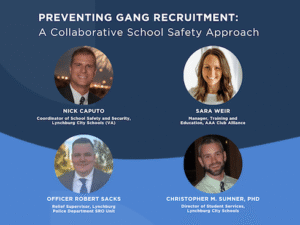
The children who are most vulnerable to recruitment are those who feel disconnected, unseen, or unsafe. Gangs offer them identity, protection, and belonging. “The allure of getting sucked into something like gang recruitment is there,” says Dr. Christopher M. Sumner, Director of Student Services at Lynchburg City Schools (VA), “It does provide that sense of belonging [even if] it might not always be a positive sense of belonging.”
Because gang recruitment focuses on belonging, gang recruitment prevention efforts must also focus on building students’ feelings of connection, positive identity, and sense of self. Successful gang prevention programs focus on
- encouraging positive peer recognition and self-identity
- providing students with age-appropriate leadership opportunities
- setting and enforcing consistent expectations for behavior
- creating a proactive, not reactive, school safety culture
Providing Proactive Support Without Labeling
Being aware of which students are at risk and proactively providing support is a large part of preventing gang violence in schools at any grade level. One of the challenges for staff is how to identify students at risk without labeling them.
“A gang member [in the family] doesn’t automatically mean a student is going to be a gang member,” explains Officer Robert Sacks, Relief Supervisor for the Lynchburg Police Department SRO Unit. “It’s just something to put on your radar that the family has gang ties or [the student] is witnessing violence.” When adults alienate students by assuming gang involvement, they risk deepening the vulnerability and lack of belonging that gang recruitment relies upon.
That doesn’t mean turning a blind eye to students who need extra support.
“We’re always briefed every morning on what happened in the city involving juveniles,” says Sacks. “I’m called constantly throughout the night because that information sharing is huge. You [need to] know if that third grader just witnessed the drive-by shooting last night and the trauma that can be involved.” SROs having access to this information allows them to communicate with the counselors and teachers who can provide extra support for affected students and collaborate with parents to prevent crises.
The 2025 National Report on Behavioral Threat Assessment for K-12 schools shows that Behavioral Threat Assessment and Management (BTAM) functions best as a preventative and supportive measure, rather than punitive, and the same principles apply for gang prevention programs. The goal is not to catch “bad kids.” The goal of gang recruitment prevention is to find the most vulnerable students and make sure they have access to the help they need.
“I’m never going to label a student based on outside factors and assume anything,” says Nick Caputo, Coordinator of School Safety and Security for Lynchburg City Schools (VA). “But there are just some kids who need extra attention or positive mentors and relationships early on.”
How School Safety Patrol Can Help Prevent Gang Violence
Leadership opportunities are one of the most effective early interventions for giving students a sense of positive belonging. School admins can implement programs like safety patrols or peer helper roles to offer structure, responsibility, and visibility.
One program that provides early leadership opportunities for older elementary school students paired with resources for staff and admin is the AAA School Safety Patrol. School Safety Patrol is free for schools to participate in, with AAA supplying all necessary equipment and materials to operate the program, including training materials for staff advisors and the high-vis sashes and hats for student patrollers.
The School Safety Patrol program trains and supports selected students as they assist with tasks like helping classmates move safely through hallways, monitoring common areas during arrival and dismissal, and serving as visible peer leaders who model positive behavior. Staff advisors guide training, assign patrol posts, and reinforce responsibility, teamwork, and communication skills among participating students.
While the program has its roots in traffic safety, it has significantly evolved over the years. To stay on top of current trends, AAA continually improves and evolves the program by proactively seeking feedback from the schools that use it.
“One of the topics that kept coming back, survey after survey,” explains Sara Weir, Training and Education Manager at AAA Club Alliance, “was that [schools] wanted more social emotional learning topics for their patrollers because these kids are faced with so much more than adults even realize when they’re that person that other kids know to go to.”
Leadership positions, like safety patroller, help students earn positive status by contributing to their school’s success, rather than disrupting class or seeking validation through external groups.
“One of the great things that happens with the Safety Patrol,” says Dr. Christopher Sumner, “Is that it does give that sense of leadership; it does give the mentorship to the younger students; it gives them something to look forward to. When they’re a part of something bigger, it sometimes fills that void.”
The Long-Term Impact of Early Leadership Opportunities
Along with supports like social emotional learning (SEL) and anti-bullying initiatives, early leadership programs provide students with a strong, protective foundation.
This foundation becomes critical as students move into middle and high school, where social pressures increase and the need for belonging and identity can create even more intense feelings of isolation and vulnerability. “Middle school is a time when kids are losing themselves,” says Sumner. “They’re trying to figure out where they belong and it’s really about getting ahead of that.”
Fostering student connectedness and providing students with age-appropriate responsibility has been proven to help reduce their participation in dangerous behaviors, including substance abuse and violence. That’s why the AAA School Safety Patrol approach of starting early and making leaders from the beginning is so effective.
Nick Caputo recalls an example of when the lessons and experience from Safety Patrol helped a middle school student make the right decision during a very critical moment: “The ‘see something, say something’ philosophy [made] that student speak up and say, ‘Hey, I saw a firearm in the bathroom. The entire school went on lockdown and we recovered the firearm… and kept [it] from being put into criminal behavior with gang activity.”
How Technology Supports Early Intervention
While early interventions provide a solid foundation, gang violence prevention works best when schools can recognize patterns, share information, and provide support consistently over time. But in many districts, important context about a student’s experiences or support needs can become fragmented as students move between grades, teachers, and campuses.
“In big cities, big counties, you might have 20-30 SROs,” says Officer Robert Sacks. “[At Lynchburg City Schools] we have five. Information sharing is huge…I can’t know everything that happens at one elementary school because we have 20 schools.” For teams of any size, timely sharing of information requires more than just email chains and word of mouth.
Centralized software like Raptor StudentSafe helps schools close information gaps by providing a secure, consistent way to document concerns and track interventions over time. Instead of relying on scattered notes or memory, SROs, educators, counselors, and other staff can maintain a clear case history that follows a student from grade to grade.
With a centralized system, schools can
- document behavioral concerns and early warning signs in one secure location
- provide appropriate visibility to counselors, administrators, and safety teams
- track interventions and follow-up actions over time
- measure the success of leadership and SEL programs
- monitor students who need additional support
By pairing proactive support systems like StudentSafe with early leadership programs that prioritize student belonging, schools can lay a stronger foundation for long-term gang violence prevention.
See how Raptor StudentSafe helps schools like yours support early gang intervention and strengthen student belonging.
Recommended Resource
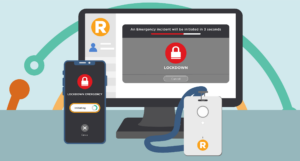
Discover how Raptor Alert helped Lynchburg City Schools prevent gang-related gun violence on their campus.
Learn how Raptor can help make your schools safer
Featured case study
No posts found!