Most conversations about school safety jump straight to emergency prep like lockdowns, drills, and crisis response plans. But day-to-day campus movements play an equally important role, from arrivals and class transitions to visitor check-ins, dismissal, and large on-campus events.
Effective school safety starts with knowing who is on campus, where they are, and why. Learn how to build accountability into daily student, staff, visitor, and event movement, with key insights from school safety leaders on creating safer campuses.
What Is Campus Movement?
Campus movement is the part of campus security that focuses on how people move through a school campus each day. This includes students, staff, visitors, volunteers, and event attendees.
Campus movement management helps schools answer the questions
- Who is on campus?
- Why are they here?
- Where are they authorized to be?
With the right tools and systems in place, schools can use this campus intelligence to proactively create a safer environment for learning and respond more rapidly and efficiently to emergencies.
The Importance of Accountability in Campus Movement
All campus movement, even the most basic everyday events like student drop-off and pick-up, introduces risk. Large campuses and complex student schedules introduce even more uncertainty and difficulty for monitoring who is on campus.
The best way to mitigate these challenges is by building accountability into your campus movement management through staff, students, and software.
Accountability for Staff
Staff accountability starts with visibility: physically seeing who is in the building, while also having shared, real-time access to visitor logs, lists of authorized individuals, student attendance and movement updates, and other important campus intelligence data. This is true even for small schools in tightly knit communities.
“Our staff, our front office staff especially, know a good 90-95% of the parents,” says Patty Messer, Executive Director and Founder at Grande Innovation Academy, a charter school in Casa Grande, Arizona. “But regardless, they have to be buzzed in.”
Hallway familiarity, paper sign-in sheets, and assumptions leave too much room for safety gaps. Even on smaller campuses, it’s critical for staff to know exactly which adults are on campus, and why, for both daily operations and emergency response.
Of course, staff can’t be everywhere and see everything at once. That’s why an integrated campus movement tool can help close those visibility gaps, but only if clear expectations are set by administration and followed by all staff.
“You can’t rely on the person next door, the executive director, or the people in the office,” says Messer. “It truly does take a village to make sure everybody is safe and accountable.”
Every aspect of safe campus movement relies on staff accountability, but it must be shared across the entire campus, not concentrated in the front office or a single classroom.
Accountability for Students
Student accountability also factors into safe campus movements. While students aren’t responsible for the adults coming onto campus, holding students accountable for their own movements, like transitions between classes, bathroom breaks, and late check-ins or early check-outs, supports better safety and behavior outcomes.
Research shows that building self-management skills and autonomy in students is linked to improved engagement and motivation and has a strong correlation with increased positive behavior outcomes. Schools that manage student movement with autonomy-supportive systems see a decrease in incidents like bullying, mischief, vandalism, etc.
“We’re not just nitpicking,” says Messer. “We’re making sure that everybody is safe and where they should be.”
Holding students accountable for their movement is more than just increasing positive behavior. Student accountability also supports a more robust safety infrastructure.
“Knowing who is where is extremely important,” says Dan Raley, Demand Generation Campaign Manager at Raptor Technologies and former fire fighter and first responder. “When your first responders show up, it’s one of the things they want to know: Is everyone accounted for? Who do we need to look for?”
When clear student movement systems and policies are in place, staff can account for students’ whereabouts quickly and direct help where it’s needed.
Tools and Systems That Help Increase Accountability
Strong, integrated systems help support a culture of safety accountability in schools. Even the most diligent staff can miss something.
When evaluating campus movement tools and systems, it’s important to look for features that lessen, not add to, your staff’s burden.
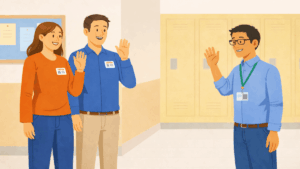
- Visitor and volunteer badges. Badges give staff immediate visual confirmation that someone is authorized to be on campus or in a hallway, without the need to double check with the front office.
- Secure, centralized data storage. Digital logs provide staff with an accurate account of recent campus activity to reference in case of an incident or emergency.
- Layered entry controls. Combining physical security, like locked doors and door checks, with clearly communicated and enforced check-in procedures reduces the chance that unauthorized individuals gain access to campus.
Paired with clear routines and expectations, the right campus movement tools help make accountability a seamless part of everyday operations, proactively reducing risk and making campuses more secure.
How To Manage Daily Campus Movement at K-12 Schools
Daily movements are where school safety is either reinforced or weakened. Arrivals, class transitions, bathroom breaks, early check-outs, and after-school activities all create opportunities for risk and confusion.
Student Movement
Student movement is constant. Effective schools plan for it intentionally and define routines for
- morning arrival and dismissal
- late arrivals and early check-outs
- transitions between classes
- bathroom breaks and hallway movement
- after-school activities and athletics
Rather than relying on vague supervision, staff should be assigned clear roles during high-movement times.
“There are about four of us who stand outside as kids enter every day,” Michelle Schreiner, Principal at Grady Independent School District in Lenorah, Texas, shares as an example. “The coaches are there as the kids enter. We’re a guardian campus, so we’ve got multiple people on campus who are trained and prepared.”
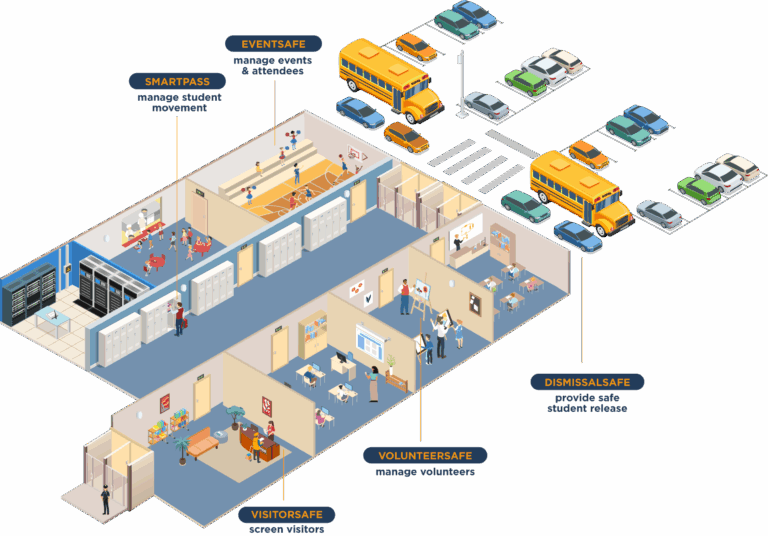
Digital student hall passes and dismissal solutions add an additional layer of security beyond just staff eyes and ears. These tools can help schools see who is authorized to be out of class, limit unnecessary movement, verify authorized individuals for student pick-up, and alert staff when something is off.
Visitor and Volunteer Movement
A wide range of visitors pass through school campuses every day, which can make visitor management feel routine, but it carries real risk if standards slip.
Schools that manage campus movement effectively hold visitors and volunteers to clear expectations during every visit. Consistency reduces pressure on front-office staff, builds trust with families, and decreases opportunity for error.
Volunteer preparation is a key part of this process. Orientation and safety training aren’t formalities; they’re crucial safety steps. When volunteers understand procedures before they arrive, entry is faster, questions decrease, and staff don’t feel compelled to make exceptions.
“All of our parents have to attend a volunteer workshop,” says Patty Messer. “Whether they’re going to come in and actually help in the classroom or if they’re just there to be a spectator for an event, we require them to go through a volunteer workshop which focuses on safety and what to do.”
Investing in a robust volunteer management system isn’t just about figuring out how to track volunteers at school. It’s about better leveraging an incredible asset. When properly prepared, community and parental volunteers become partners in maintaining a safe campus, rather than potential liabilities.
How To Manage High-Traffic Events at Schools
Large events can dramatically increase the foot traffic and chaos on an already busy campus, adding to the burden of visitor and volunteer management.
Back-to-school nights, performances, assemblies, and sporting events can bring hundreds of additional people onto campus in a short window. Without preparation, lines grow, visibility drops, and staff are stretched thin.
Pre-registration, pre-printed badges, and clear event workflows help maintain accountability and school event safety. “[Using] Raptor, you can pre-print badges so that they’re ready to go,” says Yvette Cavender, Grammar School Principal at Coram Deo Academy in Texas. “You have them in alphabetical order, and you just pass them out. Then all you’re scanning for is unfamiliar faces and people who didn’t go through your pre-approval and registration process.”
Targeted school event safety software, like Raptor EventSafe mentioned by Cavender, helps schools
- reduce bottlenecks at check-in
- screen event registrants for dangerous individuals
- manage event cancellations or changes
- document attendance for post-event follow-ups or safety audits
Top Solutions for Movements on Mobile Campuses
Whether the focus is students, staff, visitors, or large events, the same principle applies to all campus movement: Safety improves when clear routines and shared accountability are at the center of your campus movement management.
Training and drills can help staff understand what to do and put those policies into action, but systems that track movement in real time make execution seamless. The Raptor Campus Movement Suite allows schools to manage student movement, visitor and volunteer tracking, dismissal, and event management all in one place.
Learn how to account for every person on campus, from arrival to departure, with the Raptor Campus Movement Suite.
Related Resources
Discover how the Campus Movement Suite can give you real-time visibility into every part of your campus.