Best Practices for School Emergency Management
In Emergencies, Every Second Counts
Past school tragedies are heartbreaking reminders of how time equals life, and that schools in crisis cannot afford even one second of delayed or inaccurate communication with 911 dispatchers and first responders. While prevention is always key, schools must be proactive and prepared with robust school emergency response strategies.

“Seconds save lives. And Raptor gives you those seconds.”
Nick Caputo, Division Coordinator for School Safety & Security at Lynchburg City Schools, VA
1. Improve Your Emergency Alerting and Notification Power
Successful response—and the number of lives saved—depends on two critical factors: how quickly everyone on campus is notified of an emergency, and how quickly emergency first responders receive accurate, specific information about the emergency.
A multi‑layered emergency alert approach to school emergency alerting ensures no critical message is missed. Best practice is for teachers and staff to have a blended approach of wearable panic alert and mobile school panic buttons that they can initiate from wherever they are on campus while also providing critical context to emergencies.
Real‑Time Communication for Effective Emergency Response
The most powerful school panic button systems are customized to your school’s emergency response protocols. They enable users to connect directly with or call / text 9-1-1 and automatically share critical details, such as caller name and precise location on campus, with dispatchers. The system should be customized to the school’s emergency response protocols, and allow staff, first responders, and incident commanders to communicate through group messaging and access your emergency operations plan.
With an integrated ecosystem of school safety technology, schools can rely on different types of visual alerts ranging from color changing strobes to visual displays that can instantly broadcast visual and text-based alerts across classroom and campus screens. The result is faster, clearer, and more contextual communication during critical incidents.
Secure In‑App Messaging Between Staff and First Responders
The best solutions have integrated in‑app messaging, which lets staff and public‑safety partners exchange secure, time‑stamped texts, images, and status checks—without switching applications or having to remember a phone number. This keeps every stakeholder on the same page, reduces radio traffic, and ensures all communications are logged for after‑action review.
TIP: Practice Response with Drills
We cannot predict emergencies, but the more your school community is trained to respond, the less chaotic and the more successful your school’s emergency response will be. Click here to read best practices for school safety drills.
Multi-Layered Emergency Notification
Many schools have invested in independent safety solutions that require separate activation. This disjointed process wastes valuable time and ultimately impedes response and recovery. Imagine if your school emergency management system, cameras, alarms, IoT devices, smart boards, and other peripherals could talk to one another without having to invest in all new systems.
What if your school safety devices and systems could talk to one another? Imagine having reliable, innovative technology that:
- Instantly activates the appropriate school emergency response (Lockdown, Evacuate, Secure, etc.) when it receives signals from your other devices
- Immediately notifies school staff and first responders while also activating your alarm systems, IoT devices, and access control systems
- Sends visual and audio alert information to smart boards and other connected digital response technologies
- Streamlines your digital emergency response activations, speeding notifications and minimizing the impact of the situation
FEATURED RESOURCE
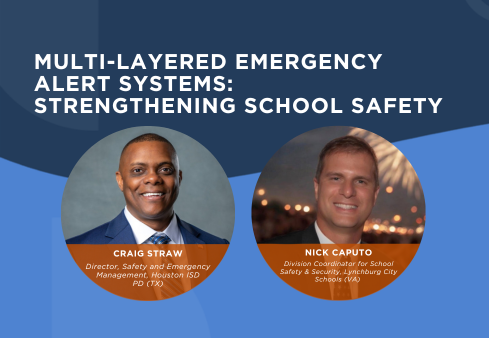
Multi-Layered Emergency Alert Systems: Strengthening School Safety
Learn more about the critical role of multi-layered emergency alert systems as school safety experts discuss how schools can strengthen crisis communication, enhance real-time coordination, and leverage new technologies like wearable alerts and 911-integrated platforms to improve emergency response.
2. Automatically Share Details with First Responders
Time and communication are critical when responding to a school emergency.
“We introduced this solution to give every employee across the district the power of being a part of safety and security. Collectively, when we are all part of the solution, it’s such a powerful approach for us. What’s even more helpful is that every Fairview Park Police officer’s phone and the fire chief has access to this app, too. We had a drill during our first week of school at our high school, and the officer who responded was here in less than one minute.” Mike Matthews, Director of Operations, Fairview Park City School District, OH
Automatically Share Details with 9-1-1
Your school’s panic button system should deliver critical, real-time data to a Public Safety Answering Point (PSAP) through a system like RapidSOS, RapidDeploy or SaferWatch. This automatically connects the caller to 9-1-1 and instantly shares additional information with the dispatcher, including:
- Caller Name and Information (e.g. job role)
- Dispatchable Address
- Callback Number
- School Name and Precise On-Campus Details (e.g. building name)
- Real-Time Status of the Emergency
- Type of Emergency (e.g. lockdown)
TIP:
When first responders can access school floor plans and maps–with buildings and doors clearly labeled–on the systems they use everyday, they can just go exactly where they are needed.
Real-Time Location Tracking During School Emergencies
If a first responder is unfamiliar with your campus, they must have detailed school maps to know how to navigate the hallways. These maps should be available in your school’s panic button system and combine floor plans, high-resolution imagery, and a gridded overlay. Having detailed maps like these (such as the ones created by Critical Response Group) will reduce response time and ultimately save lives.
FEATURED RESOURCE
Podcast: Improving Emergency Response Planning in Schools
A Conversation with Dr. Vincent Iturralde, Chief Operations Officer for North Chicago School District 187, on emergency response planning in schools.

3. Real-Time Tracking and Accountability Across Campus
It is important for incident commanders, emergency response teams, and law enforcement to know everyone’s location and condition. Best practice is to use an accountability solution—ideally one that is integrated with the panic alert system—that enables teachers and staff to quickly see their class rosters, search for others by name, and share statuses with first responders and incident commanders.
Know How Everyone is Doing
The best solutions allow first responders to see details of each individual, including their location, status, medical conditions, and allergies. If they are students, it should also list their guardians’ contact information. Incident commanders also need a clear, real-time line of sight for every person on campus. By having this information readily available, incident commanders and law enforcement can quickly see what injuries people have and how critical their injuries are.
This level of transparency allows emergency personnel to deploy resources where they’re needed most.
FEATURED RESOURCE
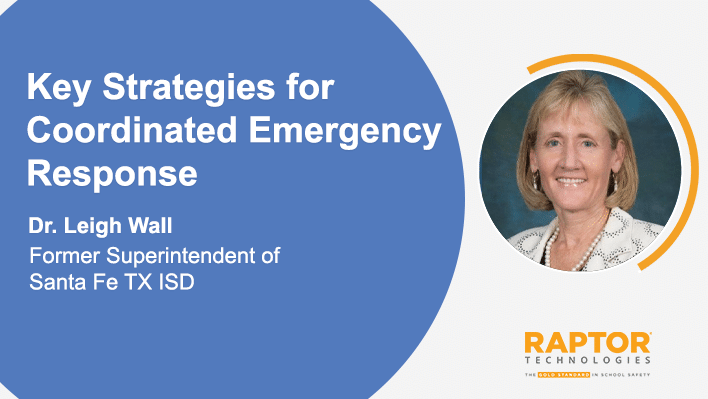
Webinar
Former Santa Fe Superintendent Dr. Leigh Wall shares lessons learned from the tragedy at Santa Fe High School.
Make Sure Everyone is Safe
Schools are obligated to make sure visitors, contractors, guardians, and others on campus are also safe. Think about this common scenario: You invite your community to attend a pep rally at your school. Would you leave the gymnasium doors open so parents and visitors can easily access the area? How would you be able to account for everyone in an emergency if you do not know exactly who is attending? This is just one reason why it’s important to use an integrated visitor and emergency management system that can approve all entrants and help you account for everyone during incidents.
4. Respond Quickly to Everyday Incidents Before They Escalate
Staff must have the proper communication tools—ideally the same mobile panic button used for large incidents—that enables them to instantly request help from the appropriate responder, like the principal or SRO, to resolve localized incidents before they escalate.
Everyday situations can quickly escalate without the presence of the appropriate personnel to identify and resolve the issue. Here are eight incidents most likely to occur in schools:
- Medical incidents such as an allergic reaction or injury
- Fights between students in common spaces
- Suspicious activity like an unknown person on campus
- Spills/flooding due to a plumbing or cafeteria accident
- Disruptive activity, for example from an irate parent
- Foul odor that may be a mistake in the lab or a prank
- Vandalism such as graffiti or property damage
- Other personal incidents requiring an administrator
FEATURED RESOURCE
Four Strategies to Address the Increase in School Violence
This white paper shares strategies for how schools can prepare for and address this increased violence and keep everyone safe.

5. Use One System for Emergencies and Everyday Incidents
Each school must have a robust school safety ecosystem, which is a toolbox of various components that can help schools quickly and efficiently respond to incidents. The toolbox considers safety and security, response and recovery processes, and what technology or software the school will use to prepare for and streamline school emergency response.
FEATURED RESOURCE
Raptor Safety Suite
The Raptor school safety suite helps schools manage every stage of safety. From approving all entrants, managing volunteers, and confidently responding to any emergency—all in one, user-friendly integrated suite.
The Right Partners
“I can’t imagine how the implementation process could be any better! We have never had a partner that provided us with as much guidance, knowledge and professionalism as the entire team at Raptor. This is the best relationship with a partner in my 28 years with Roanoke County Public Schools! We will gladly be a reference for Raptor with any school district in Virginia or beyond. And the best part is that our district feels confident in the security tools that we are providing… and we feel safer with Raptor!” Jeff Terry, Director of Technology, Roanoke County Public Schools, VA
Addressing your complex school safety needs does not have to be daunting. You don’t have to—nor should you—do this alone. Knowledgeable and trustworthy partners make all the difference. When choosing a partner, consider the following:
- Look for a vendor who asks you questions to tailor your emergency management implementation and solution, rather than simply presenting a menu of their products.
- Beyond implementation, you need a partner that makes themselves available and provides resources to encourage your continued success for years to come. This may include opportunities for development sessions, data analysis and business reviews, webinars, and other events.
- As your school or district encounters changes to staff, protocols, requirements, and expectations once your emergency management solution is in place, you need a partner dedicated to your continued success, from strategy to implementation to maintenance and updates.
You want a knowledgeable and proactive partner involved every step of the way. You should also seek partners already aligned with the best practices discussed here.

Request a Demo
See why Raptor is the leading provider of integrated school safety software solutions
"The safety of our students and staff is our #1 priority and having Raptor gives us that extra sense of security."

"Having an all-in-one solution, like Raptor is the best!"

"I think Raptor offers the best in its class. Nothing beats it."