
Raptor staff visited Pecos-Barstow-Toyah ISD (TX) for a reunification drill. Raptor, district staff, and city staff discussed plans and what resources are available to improve emergency response.
Reunification Priorities and Objectives
Your reunification plan should be built around these priorities and objectives:
| PRIORITIES | OBJECTIVES |
|---|---|
| Student and staff safety and wellbeing | Accounting for every student |
| Student and staff location and condition | Accounting for every staff member |
| Identifying missing students and staff | Reunifying every student that can be reunified |
Knowing student status—including if the student is accounted for, missing, or injured—is critical, but this information is easily lost in the chaos of pen-and-paper reunification processes. It’s best practice is to give teachers, staff, first responders, and incident commanders instant access to real-time student data, status, and location.
When a guardian checks into the reunification site, the greeter can quickly confirm if the student is safely at the site, and move on to next steps. If a student is marked missing, on the other hand, the greeter will immediately know to escort the guardian to a private waiting area for further information.
Arriving safely to the reunification site is only one part of the equation, though. It’s also imperative that staff safely reunify students with the correct person. The reunification team should have real-time access to the Student Information System (SIS) to accurately confirm guardians’ IDs, check for sex offender status and custodial restrictions, and capture a signature at reunification. This eliminates inaccuracy, reduces liability, and ensures students are only reunified with approved guardians.
“Our parents were very impressed [with our reunification process]. They saw our team checking IDs and using their mobile phones to direct the reunification. They knew that no mistakes were being made. We’ve heard nothing but positive remarks.”
– Bruno Dias, Former Director of Safety, Weatherford Independent School System (TX)
Practice Makes Perfect
Just like any aspect of emergency management, your reunification process can only be effective if you practice it. Schools should rehearse reunification multiple times, so faculty understand the established protocols and their specific responsibilities. Every drill or exercise should strictly follow your reunification plan.
This allows your school community to gain more familiarity with the plan and more confidence with each practice. It also creates muscle memory that increases response efficiency.
Drills also provide an opportunity to test your policies and procedures, revealing any areas of weakness in your response. Your team and the appropriate students, staff, and first responders should debrief after each drill or exercise to discuss what went well and what needs correction or improvement.
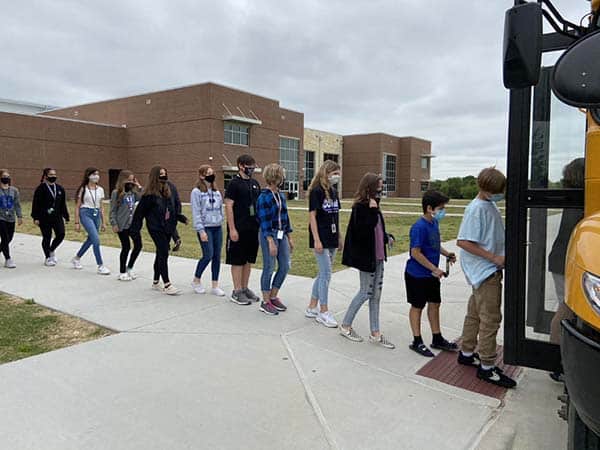
At Midlothian, students followed evacuation protocols and loaded the school buses during an emergency tornado drill.
Streamline Reunification with Technology
Schools have a lot to keep track of during reunification. The Standard Reunification Method (SRM), a free resource from The “I Love U Guys” Foundation, provides proven methods for planning, practicing, and achieving a successful reunification. Yet even with these methods, successful reunification can still be a chaotic, anxiety-filled scene.
With the right technology partner, though, you can reduce some of that chaos, creating a faster, safer reunification plan. Raptor Emergency Management is 100% aligned with the SRM and is up to 4x faster than paper-and-pencil based methods. With Raptor, you can streamline reunification and ensure your school:
- Follows each step of the process
- Accounts for every student and staff member, including tracking their location and status in real-time
- Reunifies students with only safe, approved guardians
- Has accurate, robust reporting during and after the event
“Knowing we have Raptor in place and can account for every student on campus and efficiently reunify them with their parents makes our schools safer.”
– Lisa Moya, Assistant Superintendent, Bay City Independent School District (TX)
Learn more about how Eugene School District 4J, in partnership with Raptor and The “I Love U Guys” Foundation, perform a parent-student reunification exercise.